Viewing Report 4th November 2018 – La Palma

Viewing time period – 18:31 – 22:06

Since the weather at 4,335 ft was cloudy with some precipitation Alan and I (Dave Shave-Wall) decided to take a trip up the mountain. The journey took around 30mins from our villa and we arrived at the new visitor centre first due to the route we took up the mountain. The centre is not finished yet even though it has been some 2.5 years being built. It’s an impressive set of buildings and has what seems to be at first glance 5 astrophotography pads with power.


We then continued the short distance to the observatories and noticed the new member of the Magic family Magic III. This is a further telescope aimed at recording Cherenkov radiation.

A little drive further and we arrived at Roque de los Muchachos. We took the obligatory sunset images as well as photos of the southern part of the island buried under blankets of cloud making several high points look like islands amidst the condensed water.

By now we were frozen due to the high winds that always occur at the very top, so we descended, stopping briefly at the GTC for more photos and then on back to the unfinished visitors centre where we would setup for the evening.

At 19:30 I took a look at Mercury through the 100mm giant Altair binoculars as it set within the blood red sky. Alan noted that the other point of light nearby and setting was in fact Antares, of course this time of year it sets early, so very different from our July trip this year when it was very much higher in the sky most of the night. Alan then moved the binos to Saturn which showed the ringed planets very crips and clearly with Titan at 11 o’clock and set within a star studded field.

Next, whilst Alan was imaging the top of the Teapot, I set about drawing M7. This was my first ever drawing, so choosing an open cluster was fairly straightforward. It took me a little under 30mins, much longer than I imagined. The following day I would find I had recorded it very well indeed seeing down to mag +11.

I then moved to NGC 188, an open cluster in Cepheus. I noted I could see it just about with direct vision (DV) however I found it more apparent with averted vision (AV), thus it was very faint.

Finally I moved on to NGC 6939 an open cluster in Cepheus (my chosen constellation this evening) and nearby and in the same field of view NGC 6946, also know as the Fireworks Galaxy close to 2 prominent stars. Now whilst in photos the Fireworks Galaxy is spectacular, in the binos it can only be seen with AV and if you know what you are looking at (or not) then you can imagine the galaxy as it is seen in photography.

Next I grabbed the 6D MkII and started to take some skyscape photos over the top of a glass roof lantern for the centre, but soon after, even though Alan was still imaging I became cold due to so often the case, not enough layers and so packed up and sat in the car. By 9pm we were heading the 30mins back down to our villa for dinner and wine. It would not be until 6:30am for me to venture back out from my warm bed to try and hunt down the comet 38p. However after much noise, maybe waking Alan as I tried to get the binos setup outside my bedroom on the patio, I for the life of me could not see the comet. Within 15mins the rising Sun ruined my view and I retired once again back to bed until 10am. The comet would have to wait until tomorrow.

Expedition Group Arrive at La Palma

Expedition members Alan Lorrain and Dave Shave-Wall have arrived for a visit to La Palma, with the express aim of checking out the North West quadrant of the island for suitability of future BASEG trips.

After arriving at the airport on La Palma around 12pm, think very early flight, the two packed their multiple suitcases into a Seat Leon estate that easily took 5 large suitcases and 4 smaller laptop, rucksack and wheelie bags.

The drive took us past Lidl just North West of the airport for a quick stop, as this was a self catering trip and then heading further West, through the long tunnel and then North through the multiple winding roads. The final piece of the drive to the villa El Sitio at the Garafia complex of 5 or so villas was fairly off road with the car just making it up the steep winding drive. 2 hours had past not including the Lidl stop so it is a fair trek from the airport. The height at the villa is 4,335 ft give or take the error from GPS and puts you above the clouds, at least on arrival.

The accommodation, 1 bedroom and a lounge with a sofa bed are adequate for the weeks stay, the bathroom, eating area, kitchen and patio areas are lovely, there is a shared pool, your own sauna and various paths around the property.

There is also a 10″ Skywatcher Dobsonian telescope with various eyepieces in the small building next to the pool free to use. An extension cable was provided and Christian, the manager who works for Tobias the owner was more than helpful in explaining how to turn off various lights that would come on during the night.

So after a long day, food was in order whilst setting up the equipment for the first nights viewing was going on.

Tenerife9 2018 Session Ends Early – Saharan Dust Stops Play

The group has had to bring the session to an early close due to the Saharan dust levels wiping out the sky quality. Known as the Calima, hot winds from the East bring Saharan dust across to Tenerife which destroys the sky quality needed for deep sky imaging.

We monitored the SONG (Stellar Observations Network Group) weather page throughout the week to assess our chances at clear sky imaging. When the red level is breached then the resident telescopes at Teide close their domes. For our purposes we were looking for dust levels around 0.001 which is below the yellow line.

Reproduced with kind permission of the SONG Telescope (data values by STELLA)

Before the Calima arrived the SQM was measured to be around 21.68 mag/arc sec2 (Bortle class 4) compared to around 20.5 (Bortle class 4/5) in the UK local area. Bob’s image also shows the visible layer of Calima dust :

Calima dust layer blocks the view to Mount Teide

It was a good week for all regardless of the common issues many of us encountered that stopped initial imaging attempts but once into the groove some nice images started to appear both for the portable deep sky imagers and those using the Mons Telescope for spectroscopy and lunar/planetary imaging (Mars/Jupiter/Saturn/Neptune/Uranus).

The founding BASEG members

We would like to extend our gratitude to the IAC for allowing us to the use of the Mons Telescope and the associated facilities ….. gracias amigos 🙂

New kit for upcoming trip to Tenerife

After a couple of trips to Tenerife with my Canon 5D Mkii, Canon f2.8 200mm prime lens on an AstroTrac as my main imaging kit, I’ll be adding a Takahashi FS60-CB with a flattener and an ATIK Infinity Mono camera to the mix.

Recent imaging for the dstl Project Argus has helped resolve adapter issues with the FS60 / Canon DSLR combination as it is a FS60 special and not a regular Wide EOS adapter that is required.  Live broadcasting to YouTube will also be a new possibility this trip with the ATIK Infinity camera.


Preparing for my first Tenerife trip

So since I don’t have a mobile setup like the veterans of the group I’m resigned to fact that I need to take most of my UK setup with me abroad. This means some serious weight to transport, so basically I have the following to pack and carry :

  • Hold bag1 (~18Kg)
    • Skywatcher NEQ6 mount
  • Hold bag2 (~18Kg)
    • Skywatcher Tripod (7Kg)
    • Counterweight (5Kg)
    • Box of accessories (~6Kg)
      • PSU, cables etc
    • Clothes …. I guess
  • Cabin bag1 (~7Kg)
    • Tak FSQ85
    • Tak focal reducer
    • Atik 460 CCD imaging camera
    • Lodestar guide camera
    • PoleMaster camera
    • Lakeside focuser control unit
    • Unihedron SQM
    • ADM Scope plate
  • Cabin bag2 (~6Kg)
    • Atik EFW2 and filters
    • Laptop & NUC
    • Various digital items (GPS, USB hard disk etc)
    • ADM mount puck and scope rings

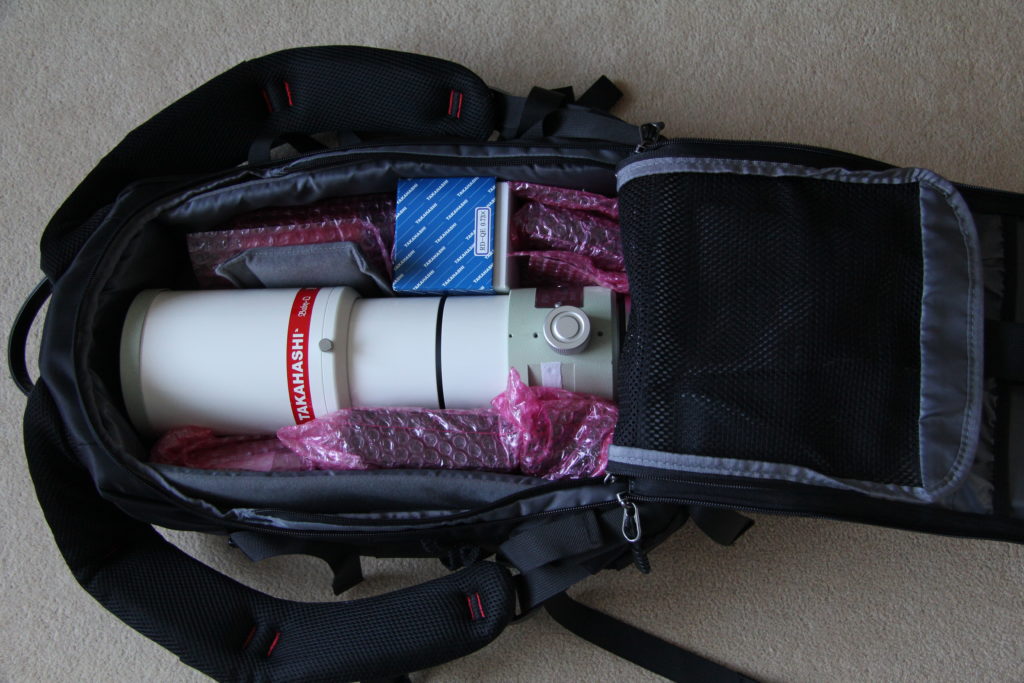
Hopefully the scope bag will in in the overhead with it’s precious contents….don’t drop it ! The laptop bag should fit under the seat….hopefully.

I won’t be sure on the final weights until the digital handheld scales I’ve ordered arrive tomorrow.

At the moment I’m just finishing the calibration and setup of the Lakeside focuser and it’s configuration in SGPro.

Update : The digital scales arrived so now I have weights for a few items and move things around a bit –

  • Hold Bag1 = 19.3kg
  • Hold Bag2 = 22.5Kg
  • Cabin Bag1 = 8kg
  • Cabin Bag2 = 8.85Kg