The BASEG members met on 11th October to plan the travel logistics for Tenerife 2027 trips, 1 (July) and 2 (September).
We discussed the Tenerife travel arrangements –
Car sharing groups to UK airport
Tenerife car hire leads and car types
Working out the human groups for the three Finkas
Arranging a date for group booking the BA airflights for September trip
We need to book the car parking for UK airport drop off for both 2027 trips
We also discussed what airline we should use for the Namibia 2028 trip given the feedback from the three BASEG members who visited Tivoli Astro Farm this summer. It was agreed that the BA trip to South Africa (Jo’burg) and then Airlink to Windhoek was problematic and time consuming effectively resulting in a lost day of imaging.
Options are using BA again or going to Frankfurt (Lufthansa) and then flying direct to Windhoek with no transit issues. The issue is the reduced luggage allowance with Lufthansa which is a single 8Kg carry on bag and two main 23Kg bags which is lower than BAs two main 32kg bags and a carry on and personal bag (no weight limit).
Also the inoculations the previous group got from their local GP for Namibia were :
A selection of the BASEG group meet last weekend to discuss the options for two trips back to Tenerife and the Mount Teide plateau. This meeting of some eight members was kindly hosted by the recently retired Dave Shave-Wall.
The group has just returned from the 2023 expedition to Mount Teide and the Parador. We have already booked next years trip back to the Parador and the wonderful staff who really our stay comfortable.
So BASEG have recently booked our flights and hotel accomodation for our Tenerife 2023 Expedition. We now have a grand total of 11 participants and as long as the world does not have a repeat of global ‘Human Malware’ epidemic or a deranged lunatic doesn’t try to blow the world up then we will going to Mount Teide for Astronomy/Astrophotography.
Quite of few of the group have been purchasing Harmonic Mounts (ZWO/Pegasus) in an attempt to reduce their travelling weight. It will be interesting to see what scopes are used on the mobile mounts …. interesting times.
After a hiatus of over 2 years due to COVID-19 and the ensuing pandemic, a group of 6 amateur astronomers have made it out to Tenerife. Alan Lorrain, Bob Trevan, Ian Piper, Mark Radice, your truly Dave Shave-Wall and newcomer Lawrence Saville.
Parador by night
Staying at the Parador hotel, situated just below the base of mount Teide at 2,158m (7,057 ft), with stunning views of the mountain towering an additional mile above our heads.
This trip was the first time more than a couple of us were staying at the Parador, due to not wishing to travel the hour up and the hour down the mountain every night and morning. Also we had been unable to make contact with the MONS telescope personnel at the observatory and the website no longer worked to allow bookings, so we were in need of accommodation, facilities and power. The Parador seemed like the perfect choice.
Relaxing during the day
We took a sensible flight out to Tenerife with BA at 1:25pm on Saturday, with their generous baggage allowance, most of us opting to fly Business due to the manageable cost which included an upgrade of the allowance from 1 x 23kg to 2 x 32kg checked luggage and the additional 23kg carry on plus an additional allowance of a laptop of 23kg! A couple of us including myself booked 2 further bags as we were carrying heavy equipment.
In hindsight we would look to travel on a different day next time due to the volume of travellers flying from T5. The BA lounge was great and a welcome retreat from the hustle and bustle of the concourse just outside. We took off slightly late and then arrived 4 hours later due to the headwind all the way and it was indeed a pleasant flight.
Nearly there … La Palma sighted
We then went through a quick security check including for our health check verification which we had completed on the SPth site prior to arrival and then waited for our bags. This turned into a lengthy stay of over an hour at the airport and then the realisation that some of our bags were still in London! So with slight annoyance and heavy hearts we set off to Cicar to collect our vehicles and head up the mountain.
The following day Lawrence and I took a trip down to the airport and were reunited with our bags sitting amongst the 50 or so that had made the trip that morning. The route back up the mountain is now our favourite with very few twists and turns and only 1 hour in duration. You take the TF-1 West out of the airport, stopping briefly at Lidl for supplies, then all the way up to Los Gigantes and then take a right, briefly following the TF-82 heading to Chio before turning left onto the TF-38. We follow the TF-38 for about 30km to the T-junction with the TF-21, turning right for the last 7km to the Parador.
Reunited with bags
Dinners at the Parador were superb, the selection was good, the quality amazing and the portion sizes were large. We were all fairly stuffed after 1 hour of eating by 9pm in time to setup in the evenings, which took place out the back of the hotel in the relative darkness by the indoor pool building.
(Dinner)
Textures of Chocolate
The Parador hotel could not have been more accommodating, they moved Bob to a new room to facilitate coming out of the lifts and getting to his room without the need to traverse the stairs. The laid out extension leads for us to various places around the patio to the rear of the hotel where the pool resides. They even turned off all the lights, closed curtains in the restaurant early and left various doors open for us to enter when we needed. They were simply wonderful!
Patio
So what was the the site like for observing? Well whilst we thought the southern horizon was going to be a problem I was observing Omega Centauri at +02 deg altitude at 11:30pm! So pretty amazing. There were various places to setup, most of us choose the corner of the patio area away from the pool building and where several piers were located.
Some setup down by the pool are also and again several piers were located there also.
BobIanAlanSkywatcher Esprit 120 ED
The piers can be booked, in case someone does turn up with a booking, through Klaus Peter Schröder, email Klaus-Peter at kps@astro.ugto.mx An interface plate needs to be made so the first visit would require taking measurements of the top plate to marry the interface plate to. Bob made up a plate before arriving for his Tak mount which worked a treat.
I now have good templates for each of the pier tops if anyone would like an interface plate making up … Bob
Time for some Solar observingSync on Venus for daylight observation after some sleep
The EM-2 and Sky90 was left tracking Venus so we could observe Venus during the day. We successfully did a meridian flip and reacquired Venus and then attempted to find Jupiter during daylight using the setting circles, but unfortunately failed but were able to re-acquire Venus.
The seeing was mixed during the week. The first night was average, the second night much better, nights, 3 and 4 were varied throughout the night. Some of use took 5min subs and others 30s or 2mins. What we found was taking shorter exposures allowed us to discard those frames where the seeing was poor and retain those where the seeing was excellent.
Omega Centauri
One evening we took a trip by foot to the the caldera where we used DSLRs to take skycape’s, a welcome break from either visual observing or telescope imaging. A variety of objects were seen and imaged and we had a lot of fun with the different rock formations. A favourite was the actually the church on the way back to the hotel.
Church
Many of us came sporting astronomy T-Shirts, Lawrence kept surprising us by showing off his cool ones we had not seen before. What a geek!
Lawrence is here!
Nights were long which was splendid and days were longer. This gave us time to process images, relax on the patio and have a beer.
Relaxing during the long afternoons
So would we recommend the Parador for an astronomy holiday? Absolutely! Will we come back for BASEG 2023? I think we know the answer to that 😎
The group has had to bring the session to an early close due to the Saharan dust levels wiping out the sky quality. Known as the Calima, hot winds from the East bring Saharan dust across to Tenerife which destroys the sky quality needed for deep sky imaging.
We monitored the SONG (Stellar Observations Network Group)weather page throughout the week to assess our chances at clear sky imaging. When the red level is breached then the resident telescopes at Teide close their domes. For our purposes we were looking for dust levels around 0.001 which is below the yellow line.
Reproduced with kind permission of the SONG Telescope (data values by STELLA)
Before the Calima arrived the SQM was measured to be around 21.68 mag/arc sec2 (Bortle class 4) compared to around 20.5 (Bortle class 4/5) in the UK local area. Bob’s image also shows the visible layer of Calima dust :
Calima dust layer blocks the view to Mount Teide
It was a good week for all regardless of the common issues many of us encountered that stopped initial imaging attempts but once into the groove some nice images started to appear both for the portable deep sky imagers and those using the Mons Telescope for spectroscopy and lunar/planetary imaging (Mars/Jupiter/Saturn/Neptune/Uranus).
The founding BASEG members
We would like to extend our gratitude to the IAC for allowing us to the use of the Mons Telescope and the associated facilities ….. gracias amigos 🙂
July 2018 sees another trip to Tenerife with friends from the Basingstoke Astronomy Society Exped Group. I had such a great time last year I can not wait to return again….Super excited.
From Tenerife, the planets will be high in the sky, the summer milky way will be glorious and there are a reasonable hours of darkness (unlike home where it isn’t getting dark at all!). Not only is the site perfect for observing (assuming it is dust free) we also get use of a 20” f15 cassegrain and facilities such as a warm room (table, chairs, kettle), outside electricity to power equipment and access to a toilet. A pleasant change from being in a layby on the hillside.
A solar system full house
I am really excited to be able to observe the planets. Being located in the far southern sky for some years to come the major planets are out of sight from my observatory, hidden behind nearby trees. The major 3 will be well placed: Jupiter, Saturn and Mars*. In the evening sky, Venus and Mercury are visible and in the morning sky Uranus and Neptune are returning.
I am wondering if it will be possible to observe all major bodies of the solar system in one go? The planets are all well placed – plus there is the minor planet Ceres, asteroid Vesta, the crescent Moon, solar observing during the day, zodiacal light, the moons of the outer planets – and in the foreground we have earth’s Mt Teide (the highest mountain in Spain). Faint Pluto is possible but at mag 14 it will be a challenge. I have observed it with the 20” dobsonian at Les Grange in France so assuming I can star hop (which is a challenge as the telescope can be rather ungainly) it should be visible. There are is also a relatively bright (mag 10 or so) Comet 21P Giacobini-Zinner that we can track from night to night.
Equipment
A key question is what equipment to take. We have access to a telescope which is fantastic for observing the planets but it is always well utilised by the group. While I would love to fill my boots it wouldn’t be fair to use it exclusively so I am taking my 6” Maksutov and a tracking mount (all second hand) along with my binoculars, camera, eyepieces, sketching equipment etc. I paid extra for my flight so I can take a hand-carry suitcase. This means I can take all my delicate optics with my in the cabin while the heavier, more robust tripods, extension cable etc can go in the hold.
This means I can be:
Observing inside the dome when it is free
Using my 6” telescope in the meantime
Chilling out with my binoculars in the summer milky way
Taking wide field shots and timelapses
I made a video of the set up I am taking and how it all fits into 2 suitcases below :
A report and video of the amazing sights we saw last year is also below
* Jupiter is just past opposition (it was at opposition on 10 June) with Saturn only a week past opposition and Mars nearly at opposition (it reaches opposition on 27 July just after we return).
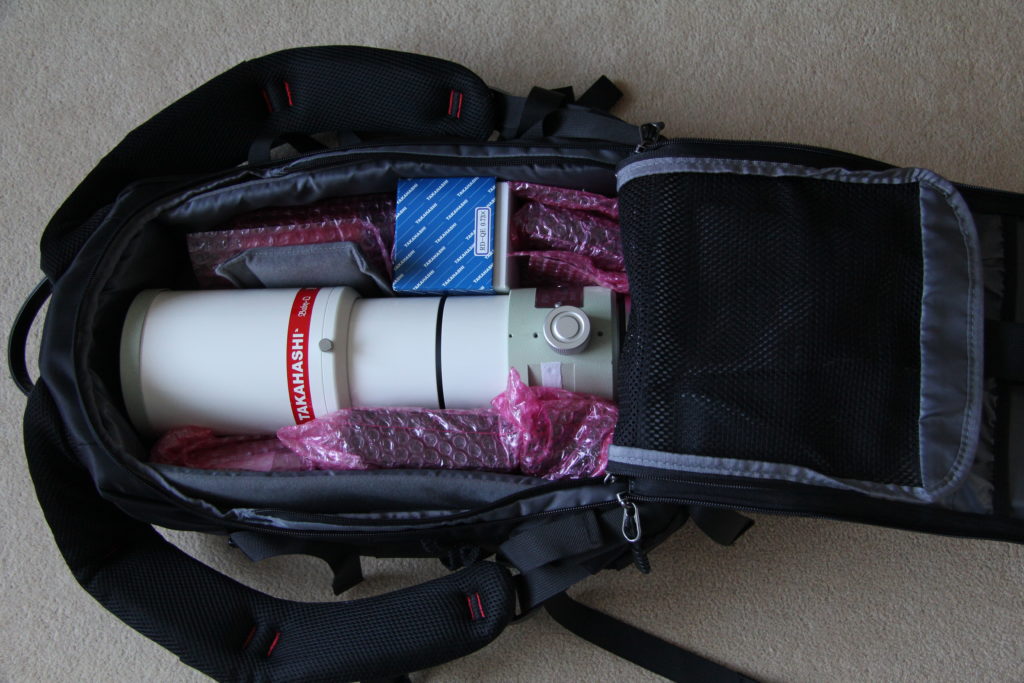
After a couple of trips to Tenerife with my Canon 5D Mkii, Canon f2.8 200mm prime lens on an AstroTrac as my main imaging kit, I’ll be adding a Takahashi FS60-CB with a flattener and an ATIK Infinity Mono camera to the mix.
Recent imaging for the dstl Project Argus has helped resolve adapter issues with the FS60 / Canon DSLR combination as it is a FS60 special and not a regular Wide EOS adapter that is required. Live broadcasting to YouTube will also be a new possibility this trip with the ATIK Infinity camera.
So since I don’t have a mobile setup like the veterans of the group I’m resigned to fact that I need to take most of my UK setup with me abroad. This means some serious weight to transport, so basically I have the following to pack and carry :
Hold bag1 (~18Kg)
Skywatcher NEQ6 mount
Hold bag2 (~18Kg)
Skywatcher Tripod (7Kg)
Counterweight (5Kg)
Box of accessories (~6Kg)
PSU, cables etc
Clothes …. I guess
Cabin bag1 (~7Kg)
Tak FSQ85
Tak focal reducer
Atik 460 CCD imaging camera
Lodestar guide camera
PoleMaster camera
Lakeside focuser control unit
Unihedron SQM
ADM Scope plate
Cabin bag2 (~6Kg)
Atik EFW2 and filters
Laptop & NUC
Various digital items (GPS, USB hard disk etc)
ADM mount puck and scope rings
Hopefully the scope bag will in in the overhead with it’s precious contents….don’t drop it ! The laptop bag should fit under the seat….hopefully.
I won’t be sure on the final weights until the digital handheld scales I’ve ordered arrive tomorrow.
At the moment I’m just finishing the calibration and setup of the Lakeside focuser and it’s configuration in SGPro.
Update : The digital scales arrived so now I have weights for a few items and move things around a bit –